Fulfilling a Commitment
In this section
When a customer subscribes to a contract price plan, a contract commitment is created for him or her according to specified terms. It is shown in the corresponding section of a customer contract.
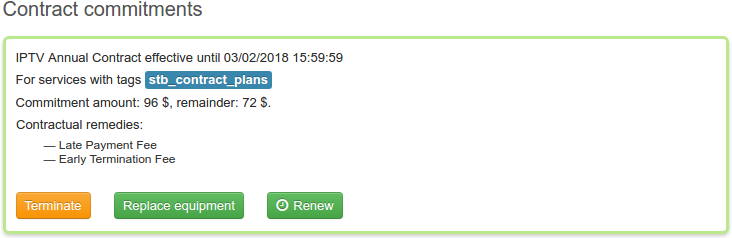
Click the commitment to view its parameters.
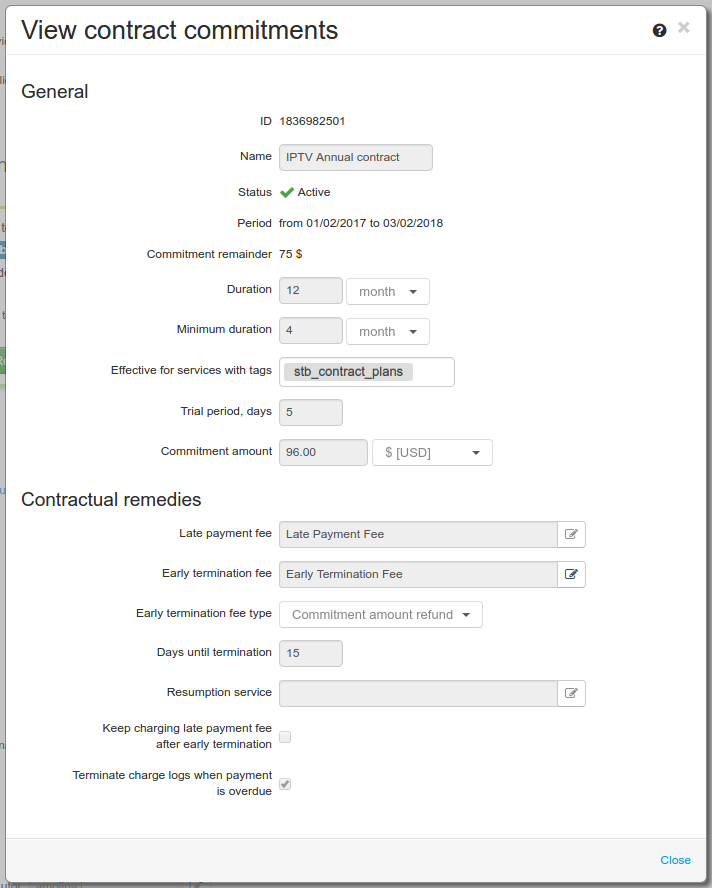
In the commitment, there is the end date of the contract period. It depends on the duration specified in the contract terms, and also on the way the customer uses the service. The contract period is calculated from the start date of the first issued charge log. If the customer pays for the service in time and uses it continually (without switching on a voluntary suspension, etc.), then the commitment should be fulfilled over the period specified in the terms (12 months, as in the example). The commitment amount remainder decreases gradually over the contract period (by $8 each month).
The following cases may happen over the period when the customer fulfills the contract commitment.
Extension of a Contract Period
When the customer is late with a next payment, the current charge log for the service closes if the Terminate charge logs when payment is overdue check box is selected in the contract terms. A new charge log for this subscription is issued when the customer pays off arrears and covers charged fees. Upon that, the end date of the contract period is postponed for the number of days equal to those from the last charge log end date till the start date of the new one.
For example, the customer has subscribed to the IPTV contract price plan, which costs $15 per month. There is a one year contract commitment created for the customer. Its status is Active, and the commitment amount is $96. A payment for the price plan is to be made within 10 days from the end date of the billing period.
A first charge log is issued on February 1, 2017, at 2 p.m., so originally the commitment is in force from 2 p.m. on February 1, 2017 till 1.59 p.m. on February 1, 2018. This charge log is closed on March 1 at 1.59 p.m. A receivable in the amount of $15 arises and is to be paid off until 1.59 p.m., March 11. On March 1 at 2 p.m. a new charge log is issued.

On March 9 the customer makes a payment in the amount of $15 and pays off the receivable. The commitment amount remainder is decreased by $8 and now equals $88. The service continues to be provided.

The second charge log is closed on April 1 at 1.59 p.m., and the customer is to pay off a receivable in the amount of $15 not later than 1.59 p.m. on April 11. And on April 1 at 2 p.m. the next charge log is issued.
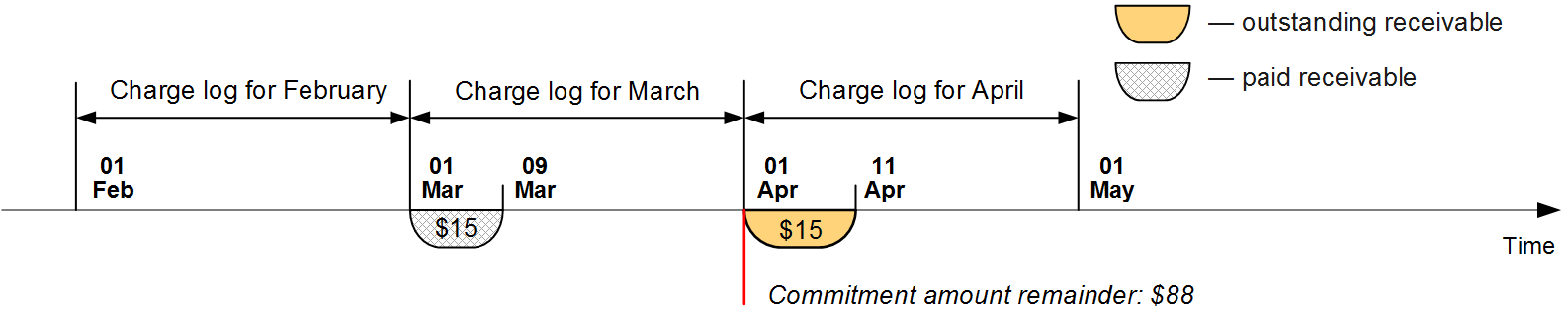
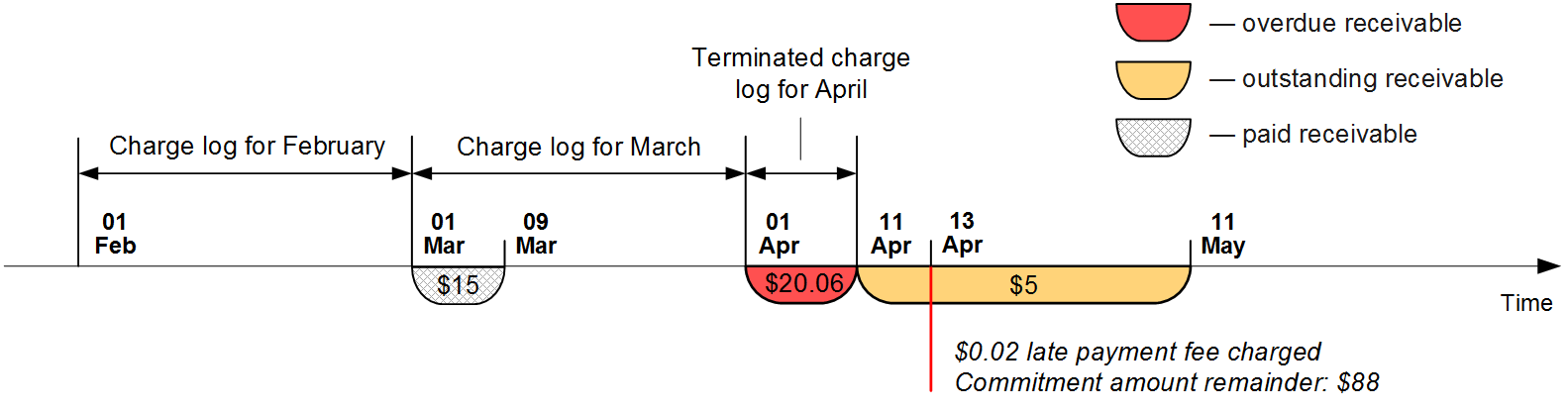
Let us study the case when the customer forgets to make another payment in time. On April 11 at 2 p.m. the receivable becomes overdue. The customer is charged a fixed part of the late payment fee (if set up), which equals $5 as in our example, and also the percentage part for the first day, 0.1% of $15. So a separate charge log for fees is issued with the total amount of $5.02.
According to the contract terms, the current charge log is terminated early and the service is disabled. A receivable in the amount of $5 for using the price plan from 2 p.m. April 1 to 1.59 p.m. April 11 arises and is to be paid off until 1.59 p.m. May 11.
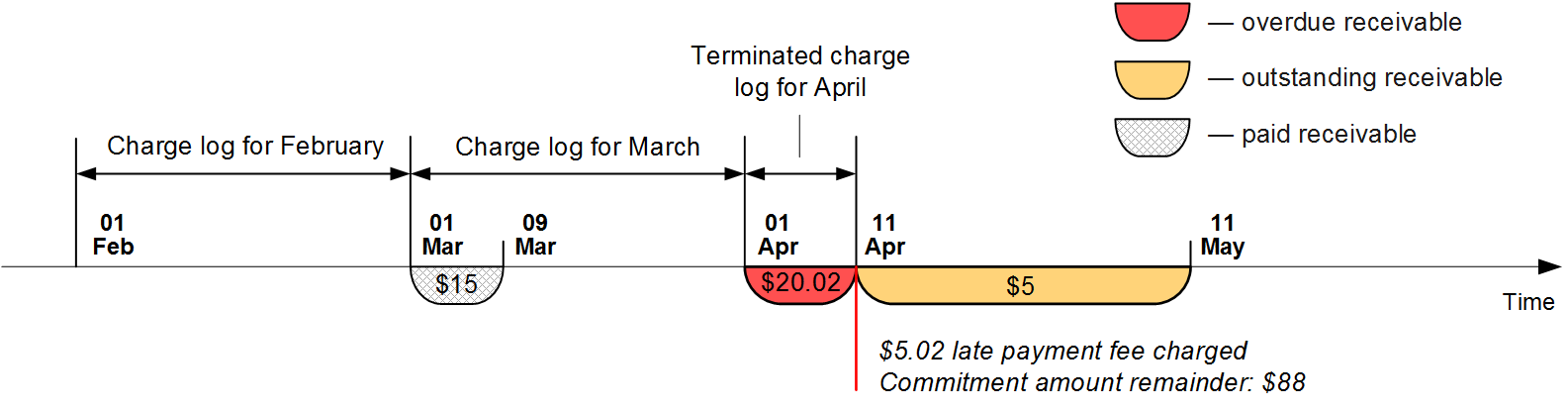
On April 12 at 2 p.m. the next percentage fee is charged: the second row with the amount of $0.02 is added into the previously issued charge log. At this time on the following day, a third row with the amount $0.02 is added. Now the customer is to pay back not only $15 for using the service in March, but also $5.02+$0.02+$0.02 = $5.06 to cover the charged fees.
On April 13 at 4 p.m. the customer tops up the balance with the amount of $21. Hydra Billing matches the payment with the receivables: $20.06 for the overdue receivable and the fees. The charge log with fees becomes Executed. The rest of the payment, $0.96, is used to decrease the outstanding receivable, so that now it is $4.06.
The commitment amount remainder is decreased by $8 (proportional to the duration of the already paid charge log for March), and becomes equal to $80. A new charge log for the price plan is issued, and the service begins to be provided.
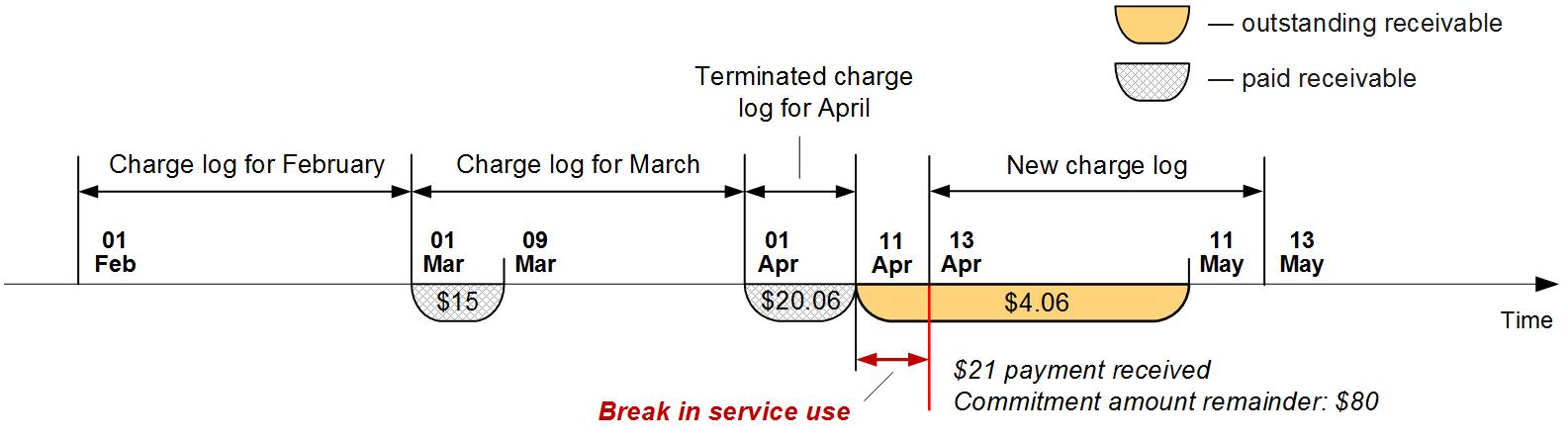
The contract period has extended for the period, during which the customer didn't use the service, — 2 days and 2 hours. Now it lasts until 3:59 p.m. February 3, 2018.
On May 10 the customer makes a payment of $5 to pay off the receivable in the amount of $4.06. So by the amount which is proportional to the duration of the already paid charge log (10 days from April 1 to April 11), i.e. (8/30)*10 =$2.67, the commitment amount remainder is decreased, and now it equals $77.33.
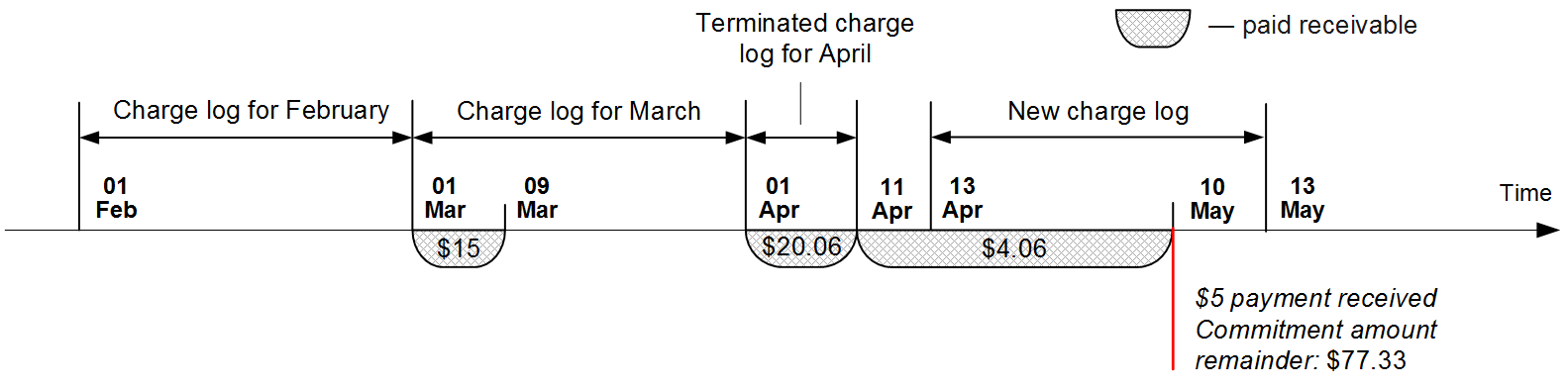
Let us say that the customer then makes payments in time. Over 9 months the commitment amount remainder decreases by 8*9 = $72. The last charge log in the contract period is to open on January 13, 2018, at 4 p.m. and to be in force until 3.59 p.m. February 13, 2018. When it is over, the customer will have an outstanding receivable in the amount of $15, and the commitment amount remainder will equal $77.33−$72 = $5,33.
When the customer pays off the receivable (he is to do it before 5.59 p.m. February 23), the commitment transfers into the Executed status, and he can change his price plan.
If a customer continues using the contract price plan after fulfilling the commitment, no fees are charged in case of late payments.
Early Termination of a Commitment
Let us say that the customer from the abovementioned example never paid for using the service in March (he was to make a payment before 1.59 p.m. on April 1). The charge log for April is closed. The customer is charged the fixed ($5) and the percentage ($0.02) parts of the late payment fee.
According to the contract terms, the commitment is terminated unless the payment is received within 15 days. Before this moment, the customer is charged the everyday fee in the amount of $0.02, which, when added to the fixed part, makes 5+0.02*15 = $5.3.
On April 26 at 2 p.m. Hydra Billing terminates the commitment and transfers it into the Awaiting payment status. The early termination fee is charged. The fee type is Commitment amount refund as per the contract terms, so to calculate the interest, the commitment amount remainder is used.The customer's current receivables are also taken into account: he is to pay for using the service in March ($15) and in April ($5 for 10 days). Having paid off the first receivable, the customer can decreases the remainder by $8, and paying off the second one — by (8/30)*10 = $2.67. Thus, the early termination fee is 88−8−2.67 = $77.33. A separate charge log is issued for this fee.
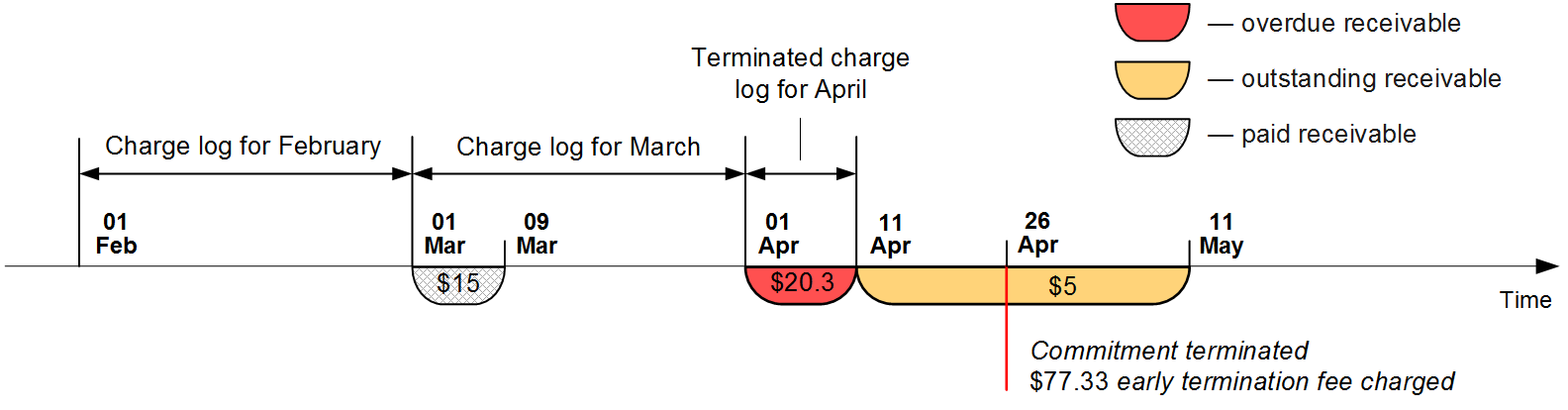
As a result, the customer is to pay $15 for using the service in March and $5 for April, $5.3 as late payment fees, and the $77.33 fee for the early termination of the commitment, so the total is $102.63.
If in the contract terms the Keep charging late payment fee after early termination check box is selected, after the commitment termination, the customer's arrears is to increase by the percentage part of the fee. And the fee is applied not only to the overdue payments, but also to the unpaid early termination fee.
Even if the contract commitment is terminated and is awaiting a payment, the customer can return back to fulfilling it. He is to pay off the receivables for the service and the fees, and after that you can cancel the early termination fee.