Concepts and Terms
In this section
See also
The functionality of Hydra Billing is based on the interaction of three basic entities — subjects, objects, and documents. Other important terms used are services, subscriptions to services, and addresses.
Subjects and Their Roles
Subject — оne of the basic entities of Hydra Billing. Basic subjects are individuals and organizations.
Basic subjects can act on the system in one or more roles: service provider, customer or bank. Each role has its own properties and way of working within the system. An individual can be a customer of several providers and an organization can be a service provider, a bank serving accounts, and at the same time be a customer of other providers. This approach allows you to avoid duplicating data and enables to structure information in a convenient way by combining attributes that belong to a particular role.
Basic subjects and their roles are predefined in the system and cannot be changed.
| Subject type | Features | Application |
|---|---|---|
| Individual | Basic subject | Used to store individual's details: first name, surname, middle name, passport details, home address, and so on. |
| Organization | Basic subject | Used to store organization's details (name, legal form, legal address, and so on). |
| Customer | Role of an organization and individual | Role of an individual or organization, used as a customer requiring services. |
| Service provider | Role of an organization | Role of an organization, used as a service provider as well as a contracting party. |
| Bank | Role of an organization | Role of an organization, used as a bank or payment system and to store current accounts of other organizations. |
| Subject group | Various types of groups: individuals, organizations, customers | Used to divide subjects even when it is not possible to classify them in other ways for example by basic contract, region, basic subject type, and so on. |
Hydra Billing allows one database to keep records for several divisions of the company providing services. They can be separate divisions of the same organization (subsidiaries, representative offices), as well as different organizations.
Technically, divisions are service providers, combined with each other in a hierarchical structure, which you can see in the section Master Data → Organizational Structure. You can create several service providers (divisions) on the basis of one organization, or each service provider can be created on the basis of its own organization.
If the company has no subsidiaries, there will only be one division in the system.
Product Catalog and Objects
Product catalog is a list of services, price plans, penalties, as well as types of equipment, network services and real estate objects.
Objects, such as CPE, provider equipment, and network services, are created on the basis of the product catalog entries. In Hydra, an object type is the entry on which the object was created. Types of equipment and network services are stored in the Material assets and Network services sections correspondingly.
You can customize a specification for a product catalog entry that belongs to any of these sections. The specification defines what components and in what quantity an object can have. Each specification item (line) is a type of an equipment or network service component.
Specification items, in their turn, also have types. Types of specification items are stored in the product catalog.
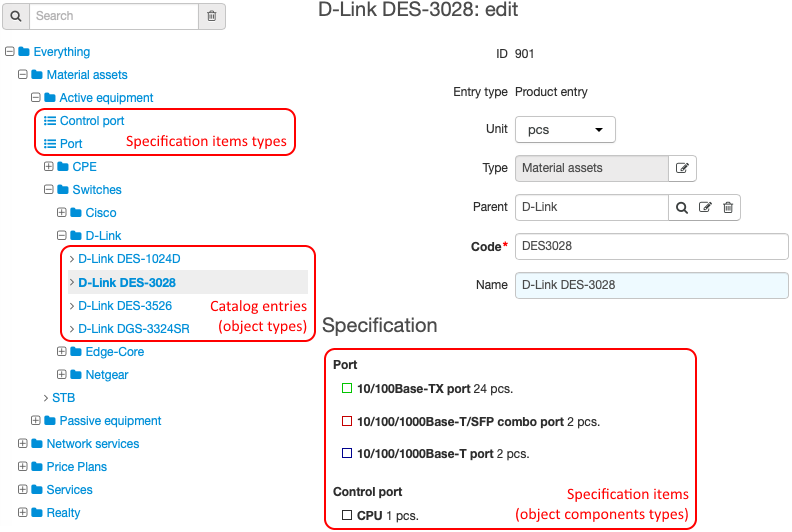
In the example above, you can see that in the Active equipment group there are two types of specification items — Port and Control port.
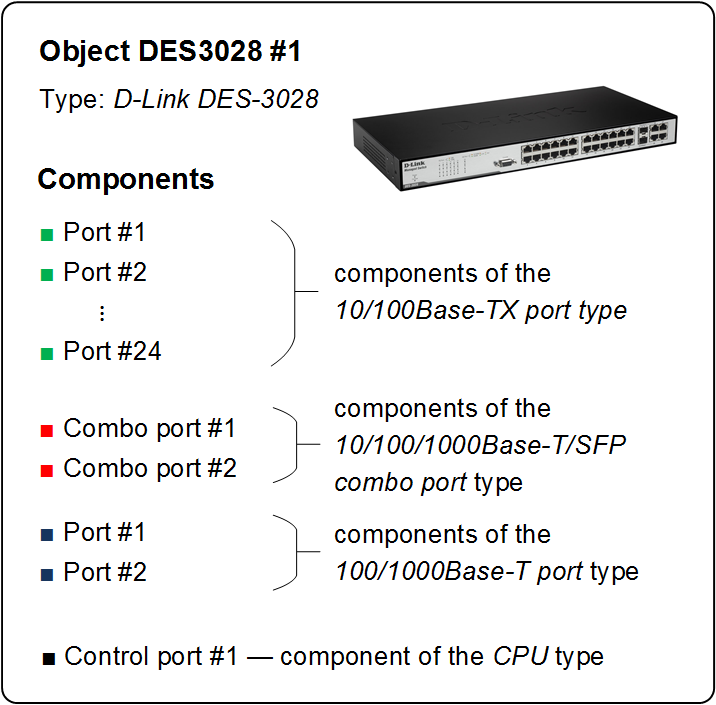
In the Switches group, there are entries for various switch models. For the D-Link DES-3028 entry, there is a specification. It contains three specification items created on the basis of the Port type: 10/100Base-TX port, 10/100/1000Base-T port and 10/100/1000Base-T/SFP combo port. A switch of the D-Link DES-3028 type can have up to 24 components of the 10/100Base-TX port type, 2 components of the 10/100/1000Base-T/SFP combo port type, and 2 components of the 10/100/1000Base-T port type.
On the basis the Control port type, the CPU specification item is created. A switch can have one component of such a type.
Documents
Hydra Billing is completely based on electronic documentation, largely reflecting the actual workflow of the service provider.
The document is the basic system entity, describing the interaction between subjects and objects. Documents come in various types.
-
Basic contract — a contract containing information about the supplier, the recipient, and the services provided. The basic contract is the basis for the creation of individual contracts. The basic contract can be applied to one customer or to a group, which allows the terms of the contract to be easily changed, especially price plans.
-
Service contract — a contract which is specific to the customer and defines the services provided to him. The service contract can be concluded on the basis of the basic contract: services can be specified in it additional to those contained in the basic contract.
-
Price specification — an annex to the basic contract or service contract. The price specification, in force on customers through the basic contract, defines services from the catalog which are included in the price plan and sets prices for these services depending on various terms. The basic price specification allows you to quickly change the terms of price plans for groups of customers. In order to create individual price plans with the corresponding service contract, a separate individual price specification is available, which defines or overrides the prices of the services you need.
-
Cash order — a financial document confirming the receipt or payment of cash.
-
Payment order — a financial document containing the order of the payer (the account holder) for the servicing bank to transfer a sum of money to the account of a specified recipient.
-
Bank statement — a document consisting of rows of information on payments received on the recipient's account for a certain time period. The statement can be uploaded into Hydra Billing manually from internet banking or automatically from any payment system. After changing the bank statement status to In force, the system generates payment orders based on the rows of information.
-
Charge log — a document issued by the provider to the customer containing detailed information on service providing: quantity, units of measurement, cost, etc. The charge log is generated after the customer has started to receive or has received goods or services. The provision of services can be fixed at certain intervals.
-
Invoice — a document issued by the seller to the buyer containing information about the composition, price, quantity, and cost of services rendered and goods sold to the customer during the billing period.
-
Exchange rates specification — a document which sets exchange rates for the currencies used in the system.
-
Period closing memo — a document that prohibits editing charge logs, invoices, payment orders, cash receipts, bank statements, and orders during its period.
-
Period opening memo — a document abolishing, during its period of validity, the corresponding period closing document.
-
Subscription migration plan — a document that defines the rules for the transfer between price plans (including change fee).
-
Discount specification — a document defining the rules and terms for granting discounts to customers.
-
Discount certificate — a document showing customer discounts from the discount specification.
The most important properties of a document are its status (for example it may be a draft, executed, declined or canceled) and its validity period.
Services
Services — actions that the provider carries out for the benefit of the customer. Examples of services could be internet access, phone calls, real IP address, and transfer between plans. The service can be one-off or recurrent. The list of possible services is contained in the product_catalog. For each service, you can choose the service providing scheme.
Service providing scheme — a saved configuration of service settings. The schemes are configured by the administrator and for each new service, you can choose a suitable scheme.
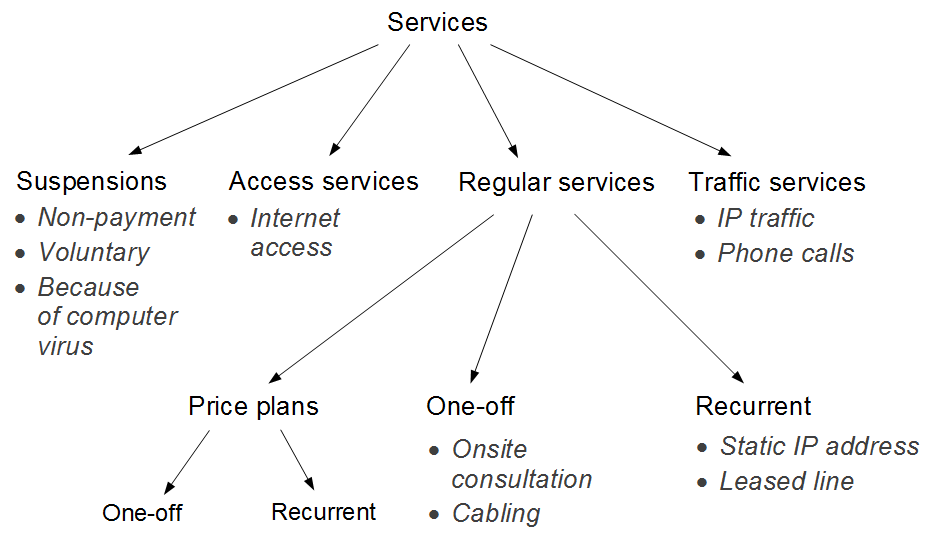
Scheme 3: Service types in Hydra Billing
There are different types of services specified in the service rendering scheme.
-
Access services — services of the same type which manage customer access to the services via events. Access services can only be part of price plans.
-
Suspension services — services with Non-payment suspension or Temporary suspension type, which block the action of other services in different ways.
-
Traffic services (data and voice traffic) — services where consumption data is fed into the system automatically, so you cannot subscribe or unsubscribe directly to them. These services can only be part of price plans. You can aggregate and archive traffic data to store information about IP traffic in a compact form.
-
Regular services — services and price plans which are not suspension, access, or traffic services. The regular price plan, however, may include access and traffic services.
Price plans — services which may contain other services. The price plan itself cannot be part of another plan. The contents of the plan and cost of services included in it are determined in the price specifications. The list of price plans is also contained in the product catalog.
In addition, services can be divided into two categories — scheduled and unscheduled. The quantity of scheduled services, if any, is known before the customer receives them; such services are already in the client's charge log when its status is changed to Actual. For example, a price plan is a scheduled service, its cost is determined in advance.
Unscheduled services appear in the current customer charge log, because the number and timing of such services is not known in advance. These services include traffic services (internet traffic, phone calls, and so on), as well as the various services included in the price plan, which the client uses in the current billing period, for example increasing the speed or resetting the limits for incoming internet traffic.
The concepts of both scheduled and unscheduled services apply when deferred payment is used for services provided to the customer.
Subscriptions to Services
Subscriptions to services is used when a customer wants to get certain services at a particular time on specific equipment, paying for them using a designated customer account within a given contract. The customer can have multiple subscriptions at the same time. Subscriptions are managed on the customer's page. Every subscription has an active period with start and possibly end dates.
Customer subscriptions may be:
-
closed, if their end date is earlier than the current date and there are no valid charge logs. Subscriptions are closed by the Preparing charge logs for recurrent services task;
-
open, if they are active now or will be in the future, irrespective of any charge logs for them;
-
current — open subscriptions active now, irrespective of any charge logs for them;
-
valid — subscriptions for which there are valid charge logs.
Addresses and Regions
In Hydra Billing the concept of address refers to both usual (street) addresses and any other types of addresses, for example MAC address, IP address, email address, ICQ or Skype number, or phone number.
Street addresses are typically based on regions, that are chosen from a special directory.