Rating Methods
Typically, when rating services, the By default rating method is used, which means no additional conditions or processing are applied to parameters and activation rules used in service providing schemes. Other rating methods are used in case a specific way of calculation is required for a service, and it cannot be implemented within regular scheme settings.
Before choosing a rating method different from the By default one, please consult with our technical support.
For each rating method in Hydra Billing there is a preset service providing scheme with a corresponding name.
Full Charging with a Fixed Billing Date
The Full charging with fixed billing day rating method is used for customers that have a fixed charging date set within a price plan subscription. If a customer has been previously provided a service (the same or a different one) with this rating method, and the last charge log for it was closed normally, i.e. a second earlier than the charging date, then, with issuing a new charge log later than the charging date, the customer will have to pay for a full service billing period, similarly to the case when Charging when opening charge log in a service activation rule is set to Full (even if it is not so).
If the previous charge log was closed early (for example, at changing a price plan immediately), or a customer is provided a service with this rating method for the first time, then charging at charge log opening will be done according to Charging when opening charge log.
Let us consider a case when a service billing period equals one month, charging is done daily, charging when opening a charge log is prorated daily, and the charging date is the first day of each month. In the previous billing period, the customer has already been provided with this service, but after closing the previous charge log normally, a new one has not been issued as the customer has insufficient funds on the account. If the customer tops up the balance on the 7th day of the month, the charge log will be issued for the period from the 7th till the 31st. However, the customer will have to pay for the whole month including the days when the service has not been used (on the 7th day the funds will be charged for the first seven days of the month).
With Excess Traffic/With Daily Excess Traffic
The With excess traffic rating method is designed to maintain a specific ratio between consumed inbound and outbound traffic, and is typically used by data centers. It is an additional post-rating method applied at closing a charge log (at the end of the billing period or early) when a total quantity of consumed services is known.
This rating method can be applied only to price plans. In the product catalog, you should set the following parameters for them:
- Predominant traffic direction, and
Excess ratio.
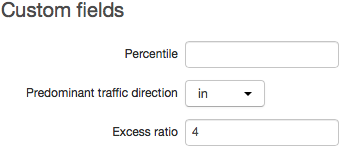
If no values are set for the parameters, the following are used: Predominant traffic direction — inbound, Excess ratio — 1.
When a charge log becomes Executed, the system defines traffic to be additionally rated according to the following formula: Texcess = Tpredominant — Treverse/k, where Treverse is the amount of traffic of the opposite direction, and k is the excess ratio. This traffic is rated as a separate service — Excess traffic. In the scheme below, see an example of the calculation when inbound traffic is considered as predominant one, and the excess ratio equals 4.
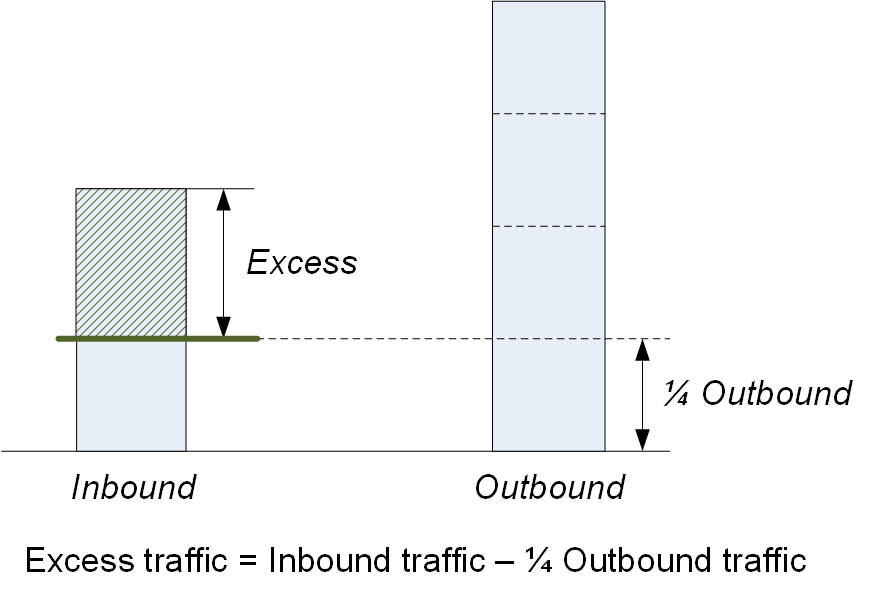
Scheme 10: Rating method with excess traffic
The With excess traffic rating method can be used to balance inbound and outbound traffic by setting Excess ratio equal to 1.
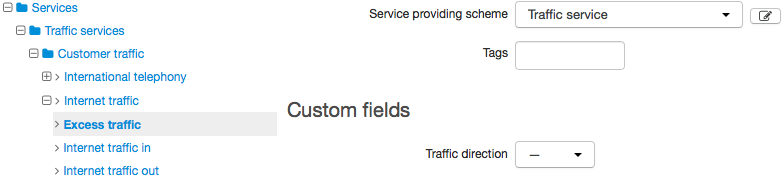
The Excess traffic service is added to the product catalog as a detailed data service with no direction specified, i.e. there is a dash in Traffic direction.
See below an example of creating a price plan with the With excess traffic rating method within a price specification.
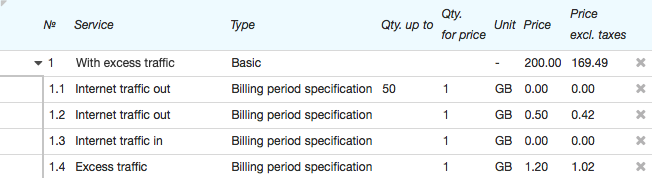
Using this method you can rate only one service (typically, Internet traffic). Make sure to place it in the very beginning of the price plan contents.
The With daily excess traffic rating method can be used in case of uneven daily traffic distribution, for example, when more traffic is consumed during weekends than during week days. Similarly to the With excess traffic rating method, it is used for post-rating when closing a charge log, although the rating is done not over the whole charge log period but for every single day.
Burstable/Burstable Daily
The Burstable rating method, just like the With excess traffic method, is a post-rating method and is used only for price plans and only when rating traffic services. Typically, it is applied when large amounts of traffic are consumed, for example, when providing services to other providers.
In the product catalog for price plans that use this rating method you should specify the Percentile custom field value (if unspecified, the value is taken as 95).

Such price plans contain services measured in bandwidth units, for example, Mbits/s.
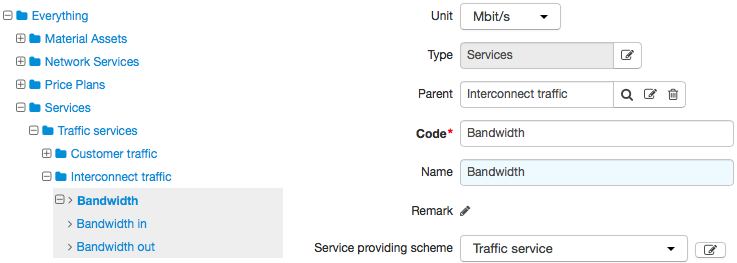
Post-rating is done on the basis of bandwidth measurements performed during the billing period. If the system receives details on traffic, not bandwidth, the bandwidth is calculated by the difference between neighboring traffic values and a time span between them.
Samples are sorted out in ascending order, then one sample is chosen according to the specified percentile. The system rates the difference between this value and a bandwidth quota defined in a price plan within a price specification. See below an example of calculation for the 95th percentile.
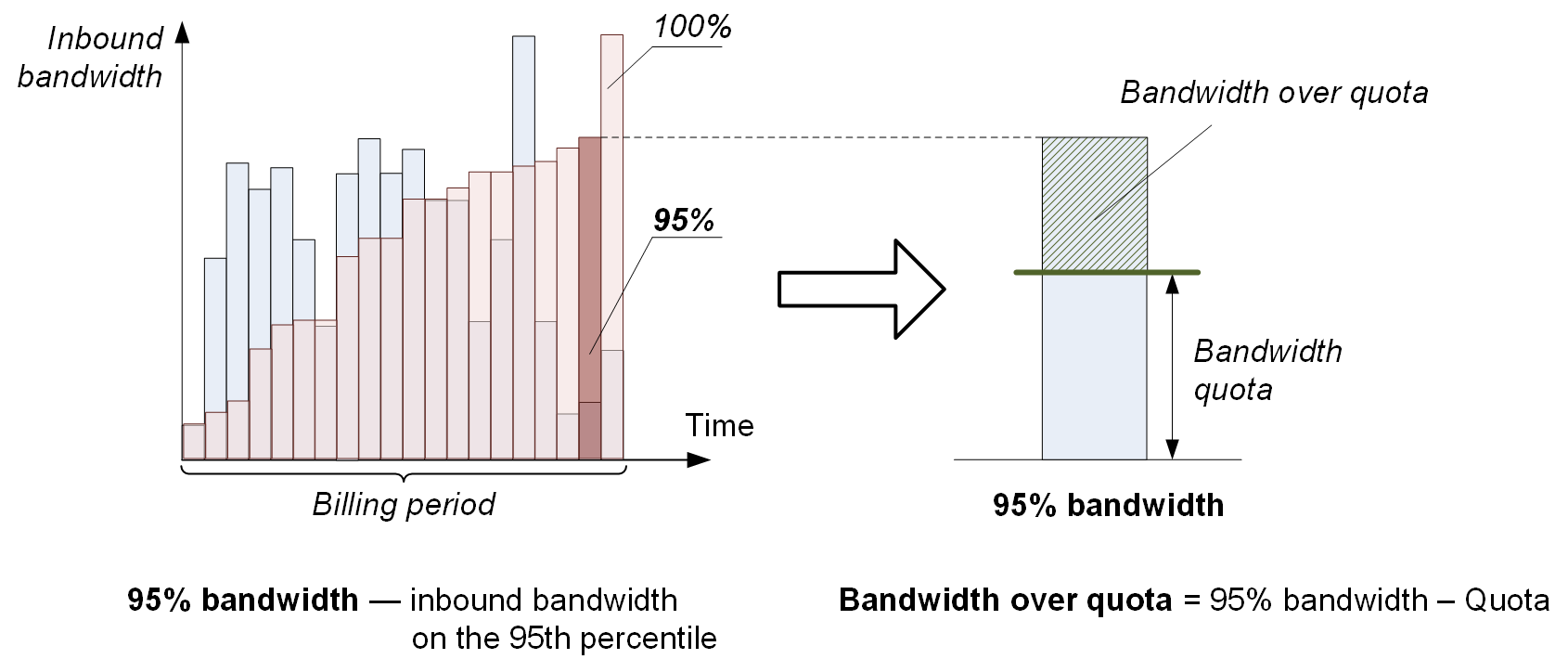
Scheme 11: Burstable rating method
Bandwidth quotas and prices are defined in a price specification.
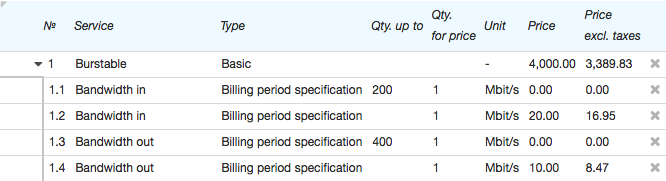
Bandwidth quota excess rating is done for all services included into a price plan that have a bandwidth unit specified as the measuring one.
Within the Burstable daily rating method, calculation is done not for the whole billing period but separately for each calendar day.