Calculating a Recommended Payment
The amount of the recommended payment depends on the period of its calculation, given in the Recommended payment period, days division parameter. It consists of four parts — the customer's debt, the amount to pay for services in the current billing period, the amount of credit limits where the end days fall in the recommended payment period and the cost of services in the next billing period (prepayment).
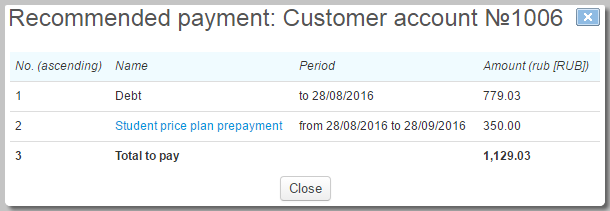
The first stage in calculating the recommended payment is to determine the funds on the customer account. This amount does not include permanent or temporary credit limits given to the customer, and is calculated according to the following formula:
funds on the account = account balance + credit limit for scheduled services + credit limit for unscheduled services.
These funds are allocated to payments for the already provided, current and future services.
Components of the recommended payment |
Description |
|---|---|
Debt (row 1) |
If the amount of funds is negative, the opposite amount is given in the Debt row, otherwise this line doesn't appear in the table. |
Payment for the price plan and other recurrent services in the current billing period (rows 2 and 3) and credit limits repayment for scheduled and unscheduled services. Is calculated for each service separately |
Payment for Services in the Current Billing PeriodThe payment amount for services in the current period is calculated as the sum of the reserved rows of the charge logs in force with charge dates between the current date and the current date plus Example 1Billing period — 1 month, from June 1 to Jun 30. Charging and reservation periods — 1 day. Period of recommended payment — 15 days. Current date — June 12. Monthly cost of the recurrent service — $30. Funds on the customer account — $2.
Since the charging period is 1 day, each day corresponds to one row in the charge log. System chooses the larger of the following periods: recommended payment (15 days = 15 rows) and reservation (1 day = 1 row). The chosen period is 15 days, from June 12 to June 27, but the funds on the account are only sufficient for the first 2 days of this period (2*$1). Therefore the system recommends a payment for 13 days — from June 14 to June 27.
Example 2Billing period — from June 1 to June 30. Charging takes place every day and the reservation period is 10 days. Period of recommended payment — 5 days. Current date — June 12. Monthly cost of the recurrent service — $30. Funds on the customer account — $2.
Since the charging period is 1 day, each day corresponds to one main row in the charge log.System chooses the larger of the following periods: recommended payment (5 days = 5 rows) and reservation (10 days = 10 rows). The chosen period is 10 days, from June 12 to June 22, but funds on the accounts are only sufficient for the first 2 days of this period (2*$1). Therefore the system recommends a payment for 8 days — from June 14 to June 22.
Example 3Billing period — from July 1 to July 30. Charging and reservation periods — 1 day. Period of recommended payment — 10 days. Current date — June 25. Monthly cost of the service — $30. Funds on the customer account — minus $5.
Since the charging period is 1 day, each day corresponds to one row in the charge log. System chooses the larger of the following periods: recommended payment (10 days = 10 rows) and reservation (1 day = 1 row). The chosen period is 10 days, but at the end of the billing period, there are only five days left (5 reserved rows in the charge log). The recommended payment period goes beyond the end date of the current billing period, so Hydra Billing asks to pay for the first 5 days of the following billing period which will last 31 days (from July 1 to July 31). Moreover, the customer has a debt of $5.
Credit Limits RepaymentIf the end of the credit limit for scheduled or unscheduled services falls into the recommended payment period, the table shows the appropriate rows with the cost of services and the periods when they were provided. If the value of the available funds minus the funds needed to pay for services in the current period remains positive, this money goes towards the credit limit repayment. Let us suppose, for example, that in the previous period, services to the value of $7.5 were provided with deferred payment. Now, there are $25 of available funds on the account and a payment of $23 is due for services in the current billing period. There will therefore be $2 left and this amount is put towards credit limit repayment for the previous period's services. So in the row for payment for the provided services there will be $5.5, not $7.5. |
Prepayment for the price plan and other recurrent services for the next billing period (row 4) |
The prepayment is calculated when the end date of the current billing period (i.e. the end date of the current charge log) falls into the recommended payment period. Its amount depends on the reservation period. If it is non-zero, then Hydra Billing asks for a payment in advance for the period starting from the begin date of the following charge log till the bigger one of the two dates: either the end date of the recommended payment period, or begin date of a new charge log postponed by the reservation period (see example 3). If there is no reservation used, the prepayment amount equals the full cost of the service for the following billing period. Thus, if you set the reservation period to zero in the example 3, the recommended payment would be:
If a customer is suspended for non-payment, the prepayment for the basic service (price plan) is calculated not at the end date of the current billing period, but when the recommended payment is determined, i.e. without taking into account the valid charge log for the suspension service. This allows the customer, who can stop the suspension at any time, to know the amount needed to pay to resume the price plan. |


