Fundamentals

Scheme 1: "Thin client" architecture
Hydra Billing is built on an Oracle database with a "thin client" architecture. The whole system business logic lies in its core on the database side, and client applications only provide user interaction and work with the core via a standardized software interface. This configuration allows you to integrate the system quickly and as deeply as possible into the company IT infrastructure, ensuring its connection with the rest of the software and hardware. In this way, Hydra Billing can be a part of the integrated solution for the service provider, performing tasks related to customer accounts, contracts, rating services, and invoicing.
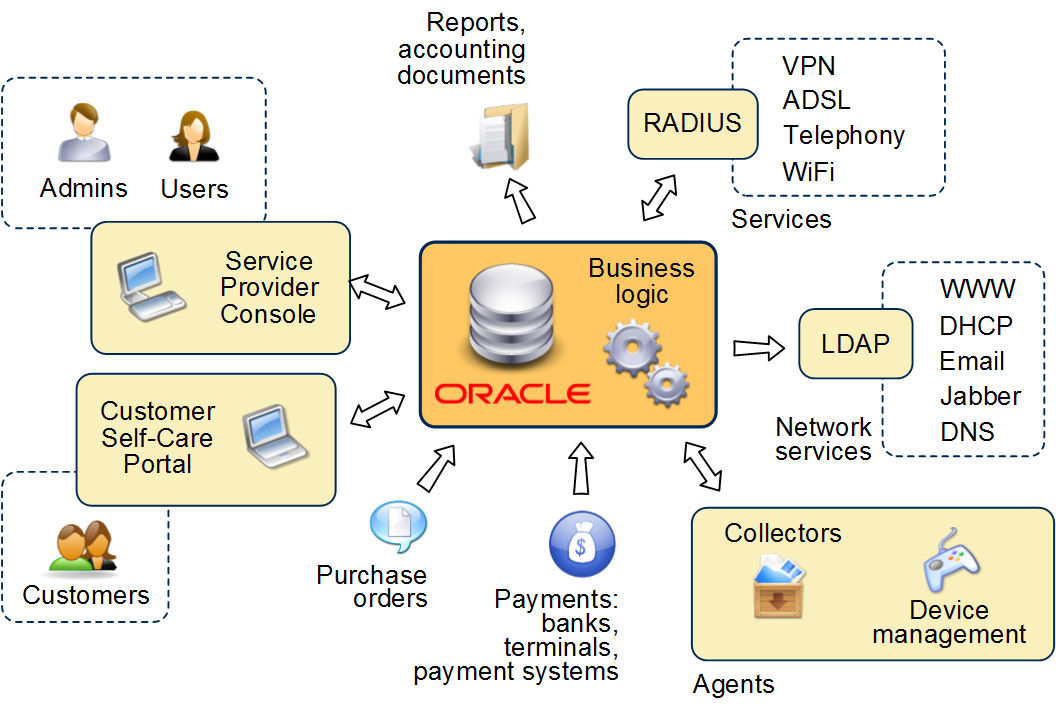
Sheme 2: General scheme of the system operation
Hydra Billing is managed through the Service Provider
application. Customers have a separate application — Customer Self-Care Portal, where they can get all the information they need about their existing services as well as independently subscribe to new services.
Important system modules are called agents. Details of services rendered are collected and transmitted to the core with their help. The special module — Equipment Management Agent — works directly with equipment, carrying out system instructions such as switching on and off customer ports. This agent supports common management protocols such as SNMP, rsh, ssh, and Telnet and works with software firewalls — in particular ipfw and iptables. The agent is also used for mass mailings of information from the system, such as invoices or notifications of a critically low customer account balance.
Another group of modules is designed to integrate Hydra Billing with various automated systems. Synchronization with the LDAP directory (or Active Directory) makes it easy to create a unified system of authorization and management of standard and non-standard network services. Integrating with the RADIUS server allows the system to gather information about the services that are being charged at that time.
Hydra Billing supports a variety of ways of entering the customer payment information. These include:
-
manual input (for single payments and adjustments);
-
downloading bank statements from an internet bank with automatic recognition of the contracting party, invoice or contract under which a payment is made;
-
automatic receipt of payments from various payment systems (credit cards, payment terminals, electronic money, and so on).
There is also a special program interface to automate payment input from non-standard systems.
Invoices for services, issued by the Billing, can be downloaded to an external corporate system. As well as the invoices, all information you need to synchronize the contracting party's reference data and product catalog can be downloaded in CommerceML format.
Hydra Billing offers a variety of ways of working with printed forms, including flexible report generation. Any document can be downloaded in printed form (compatible formats include OpenOffice, Microsoft Word, and HTML), and because of the variety of formats, every kind of document can be produced in several ways. You can therefore create different views of the same document, including various data groups.
The system may receive external purchase orders from the provider or the clients themselves on the company website.