An Example of Paying Off Receivables
In the following example, a customer has subscribed to a contract price plan which costs $24. Charging is carried out at the beginning a month, and there is a 10-day deferment of payment starting from the end date of a charge log. In case of a late payment, a daily fee is charged at the 0.1% rate above the overdue amount. Also, in case there is an overdue receivable, the current charge log is terminated.
Initially, the customer account balance is $0, with $0 available funds. On February 1 at 2 p.m. the first charge log for the service is issued. The subscription fee is charged, so the account balance becomes −$24, and a credit limit for scheduled services is set to $24 until 1.59 p.m., March 11. The available funds are $0.
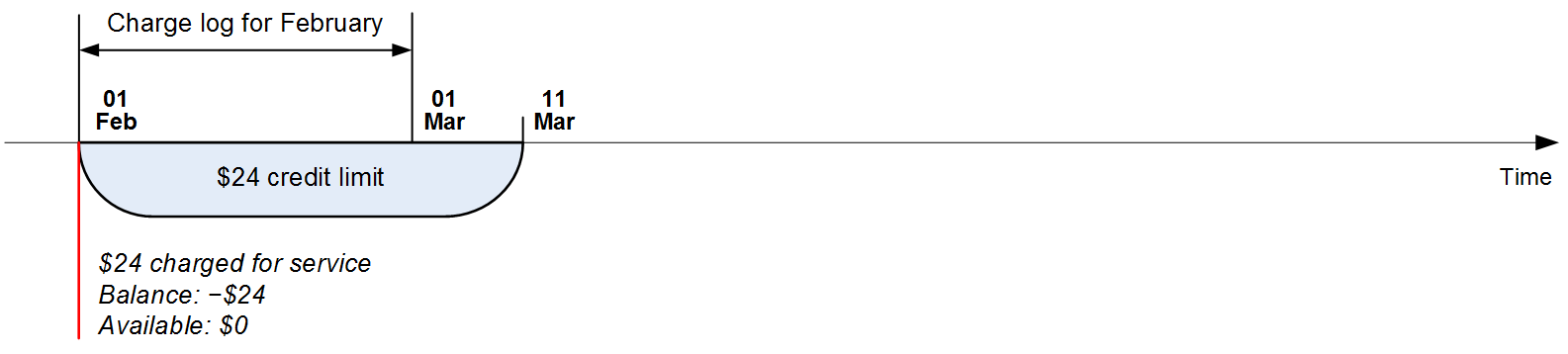
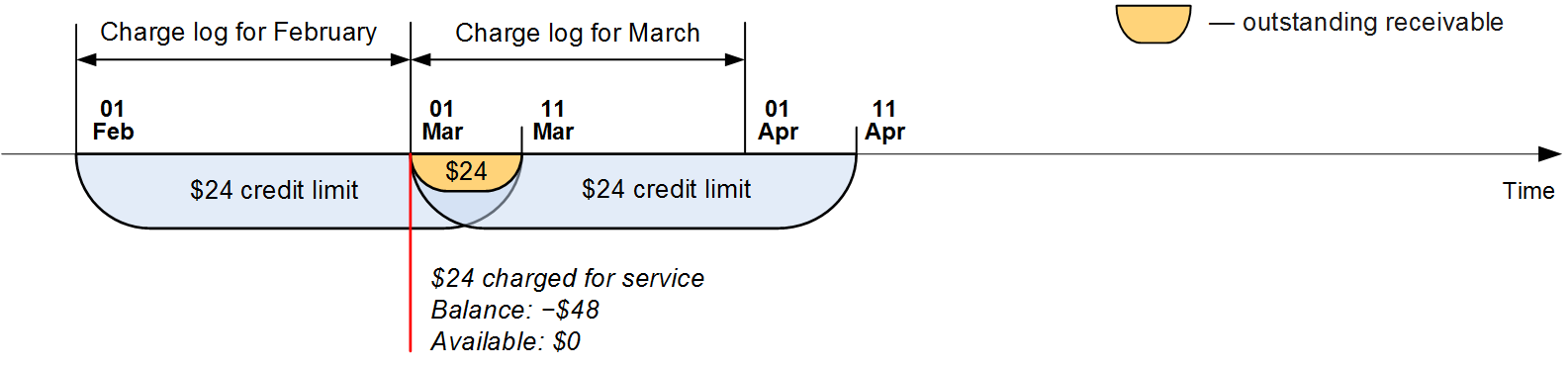
On March 1 at 1.59 p.m., the charge log is closed. Thus, a $24 receivable arises, with the payment period from 1.59 p.m., March 1 until 1.59 p.m., March 11, with the Outstanding status. The payment allocation is carried out: for the current moment, the customer has no unmatched funds, so the receivable remains unpaid.
At 2 p.m. a new charge log is issued. The subscription fee is charged, and the balance becomes −$48. One more credit limit is set to $24 until 1.59 p.m., April 11. There are no available funds: the negative balance is fully covered by the two credit limits in force.
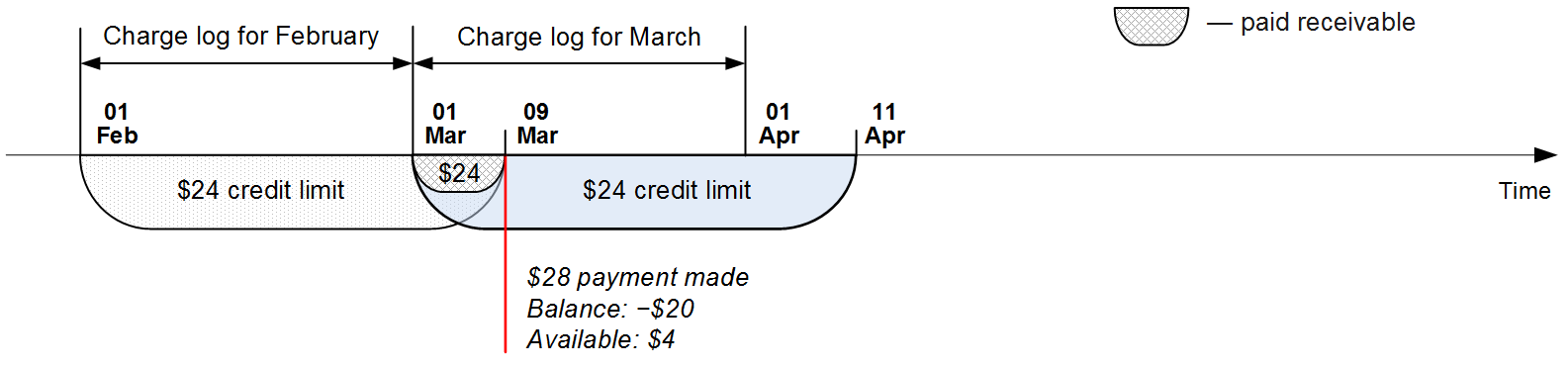
On March 9, the customer makes a payment of $28. Payment allocation is carried out: the amount is enough to pay off the only receivable the customer has. So it is transferred into the Paid status, and the amount of $4 remains unmatched. The first credit limit is closed. The customer's balance becomes equal to −$20, and the available funds are equal to $4 (−$20 added to $24 of the second credit limit).
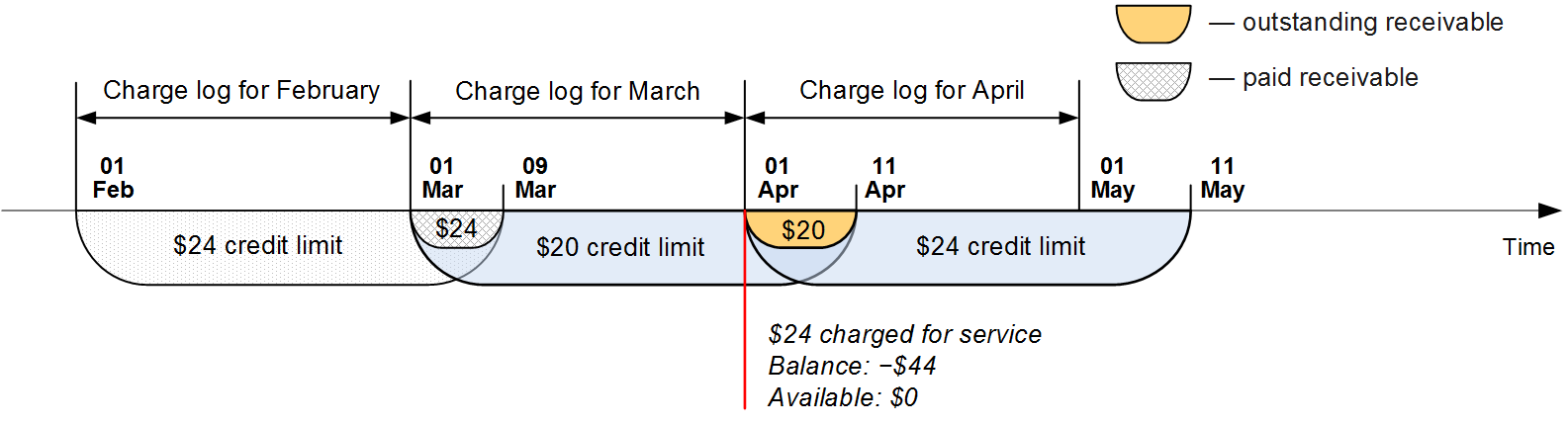
On April 1 at 1.59 p.m., the charge log for March is closed. A receivable in the amount of $24 arises and to be paid off until 1.59 p.m., April 11. Payment allocation is carried out: a customer has an unmatched remainder left from the previous payment. It is used for partial paying off the receivable: its amount equals $25−$4 = $20. Consequently, the amount of the second credit limit is decreased: now it equals $20, and is still in force until 1.59 p.m., April 11.
The next charge log is issued for the period beginning from 2 p.m., April 1, until 1.59 p.m., May 1, with a new $24 credit limit in force until 1.59, May 11. The balance equals −$44, with no available funds.
Let us suppose, that once the customer forgets to make a payment in time. So on April 11 at 2 p.m. the receivable becomes overdue. The late payment fee is charged: a charge log in the amount of $0.02 (0.1% above the overdue amount) is issued for the first day in arrears. The balance equals −$44.02. A $0.02 receivable arises. As there is no deferment for fees, this receivable instantly becomes Overdue.
At the same moment, the $20 credit limit gets over. The remaining $24 credit limit cannot cover the negative balance, so the charge log in force is terminated due to insufficient funds. The amount to be charged is recalculated for the number of days the customer has used the service: instead of the $24 amount, the charge log now contains the $8 amount charged for 10 days of using the service (from 2 p.m., April 1, until 1.59 p.m., April 11). The credit limit is reduced to the same amount. Now the balance equals −$28,02. Additionally, an $8 receivable arises. The receivable is to be paid off before 1.59 p.m., May 11, as in case of an early termination of a charge log, days are counted from the scheduled closing date, not from the current one. Payment allocation is carried out, but the customer has no available funds.
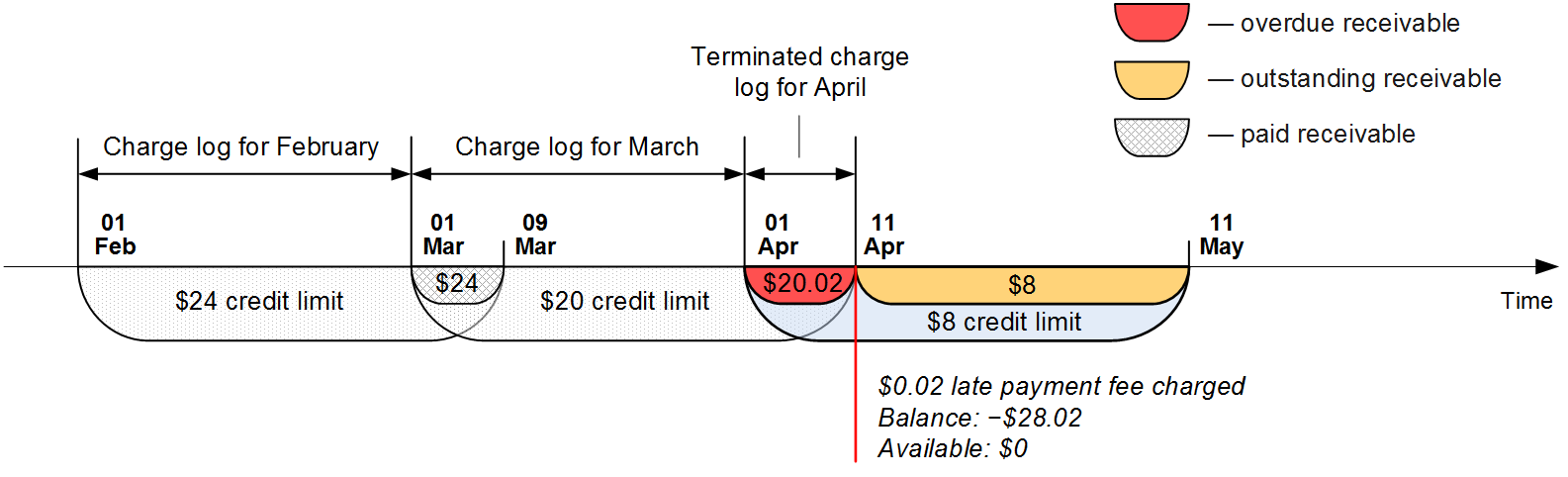
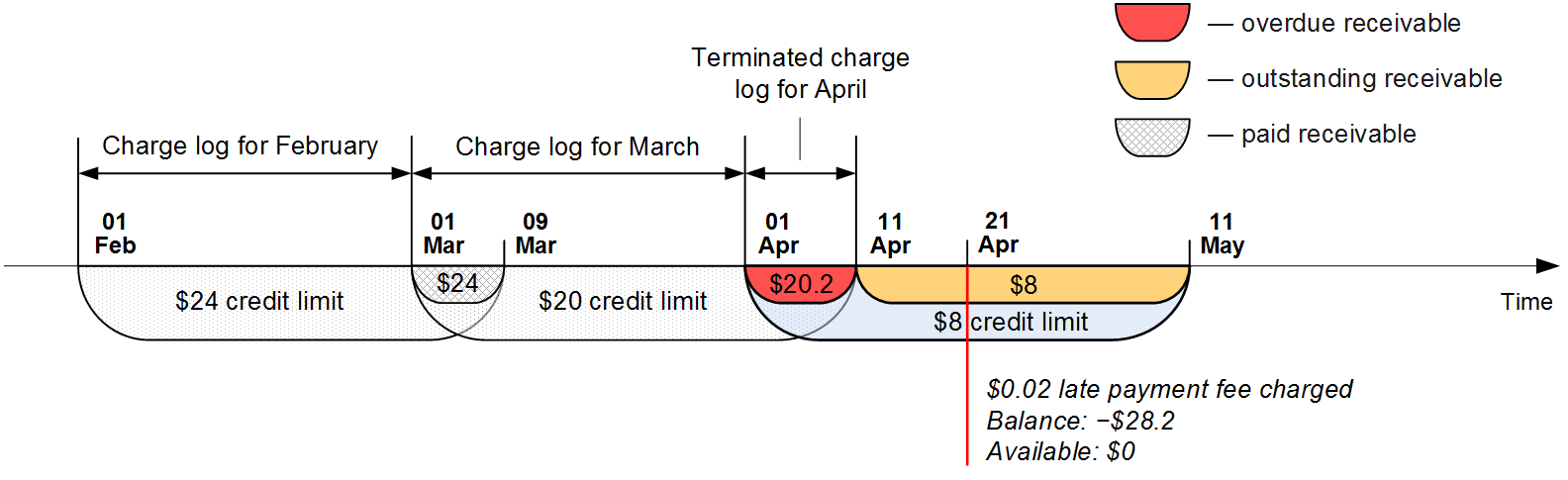
Over each consequent day, the amount of fees increases by $0.02. On April 21 at 2 p.m., the next charge is carried out. The amount of fees becomes equal to $0.2, and the balance is −$28.2.
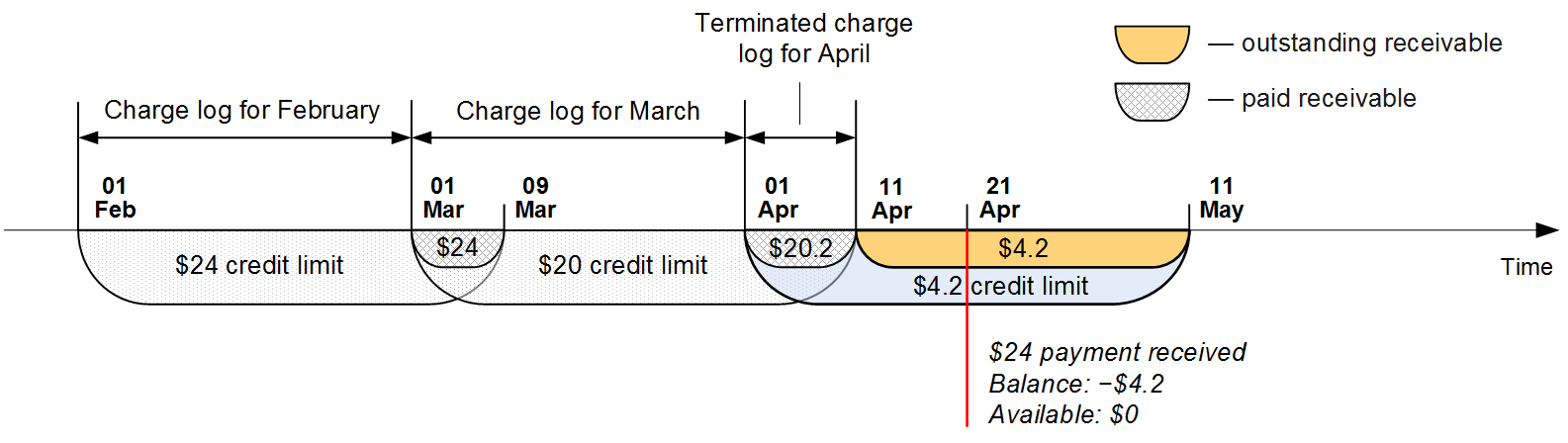
Then, on April 21 at 6 p.m. the customer makes a payment in the amount of $24. The balance becomes equal to −$4.2. Payment allocation is carried out. Currently, the customer has three receivables: an overdue amount of $20 for using the service in March, an overdue amount of $0.2 for the charged late payment fees, and a receivable in the amount of $8 for using the service in April.
First of all, the overdue fees are paid off, and $23,8 remain unmatched. Then, the same with the overdue receivable for using the service, so that and $3,8 remain unmatched. These funds are used to partially cover the third receivable, as a result it now equals $4.2. The corresponding credit limit is also reduced, and now equals $4.2 which is to be paid before 1.59 p.m., May 11. No available funds remain.
The service is resumed: a new charge log is issued for the customer, which is to be in force from 6 p.m., April 21, until 5.59 p.m., May 21. The subscription fee is charged, so the balance equals −$28,2, and a new $24 credit limit is in force until 5.59 p.m., May 31.
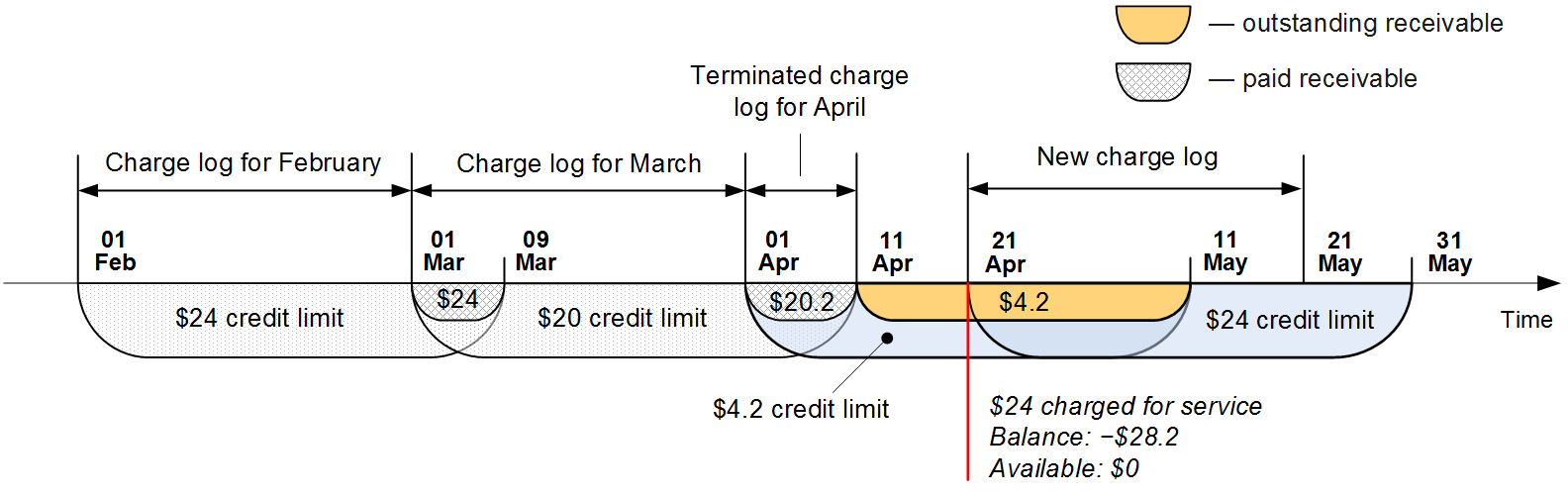
See the chart showing the changes of the customer account indicators.
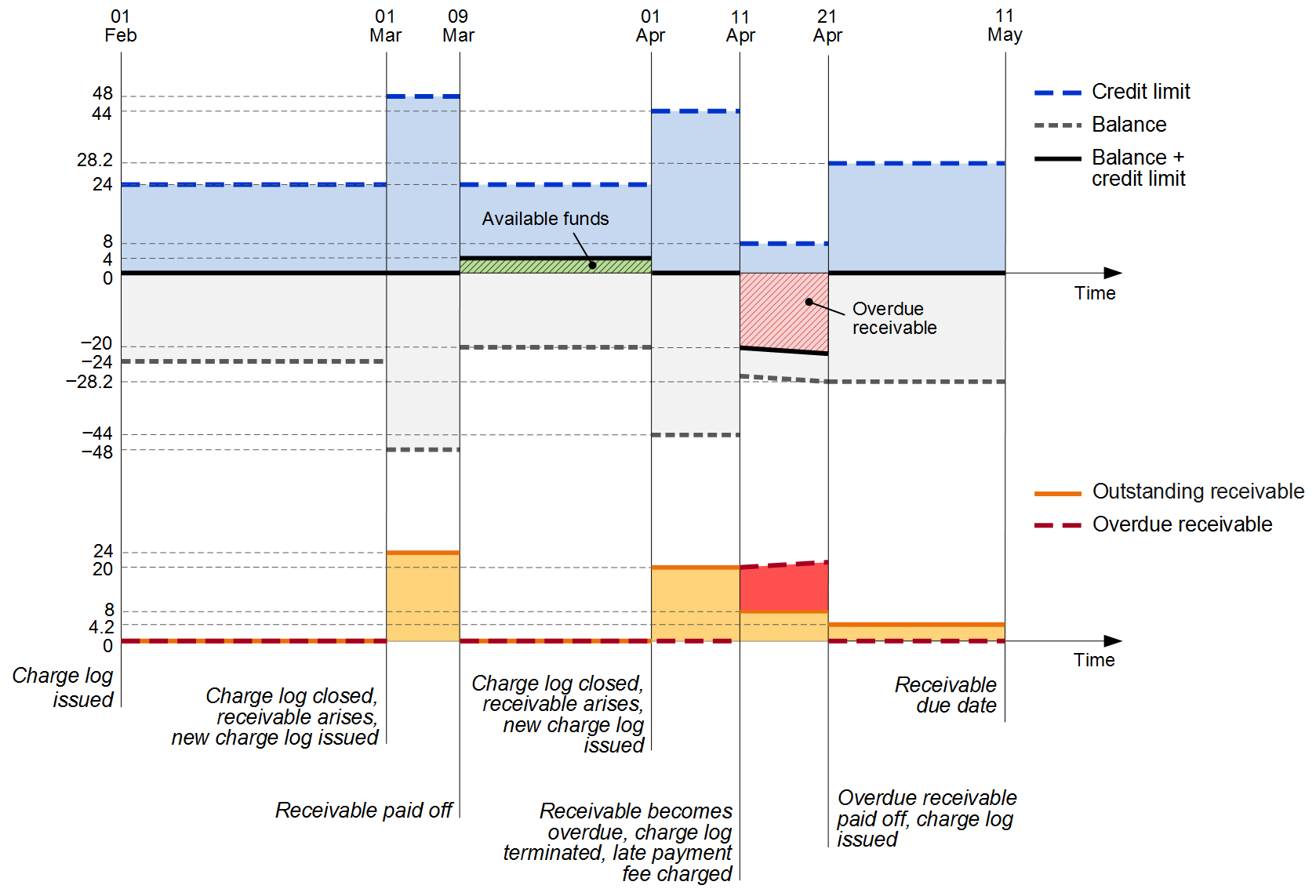
Scheme 6: The balance, credit limits, and receivables of the customer