Matching Payments to Receivables
Matching customer's funds is carried out:
-
when a payment arrives,
-
when a charge log becomes Executed,
-
before charging a fee for an early termination of a contract commitment, and
-
when canceling a charge log.
The Order of Matching Payments to Receivables
Each payment arrived at a customer account is matched to customer's receivables. If there are several receivables, they are sorted and paid off in the following order:
- By the type of a receivable — firstly, the late payment fees are paid off,
- By the status of a receivable — firstly, the overdue ones are paid off,
- By the begin date of a payment period — the earlier a period to pay off a receivable begins, the quicker it is going to be paid off,
- By the due date of a receivable,
- By the priority of a service, for which the receivable has arisen. If a customer is to pay off receivables, which are created on the basis of payments (those with a negative amount, or made from the customer account), they are sorted by the priority value set in the Matching priority for payments division parameter,
- By the amount of a receivable — larger receivables are paid off first,
- By the begin date of a contract commitment — the earlier the date, the sooner a receivable is to be paid off.
In the beginning, the amount of unmatched funds equals the payment amount. If the funds are enough for paying off the first receivable on the list, then the receivable becomes Paid, and the amount of unmatched funds decreases by the amount of the receivable. Further, the unmatched funds are used for paying off the next receivable, etc. If the unmatched funds are insufficient to cover the whole receivable, it is paid off partially: its amount is decreased by the unmatched funds, and the payment period remains unchanged.
Allocation stops in the following situations:
-
At the time of matching a customer has no receivables, then the payment remains fully unmatched.
-
All receivables become paid off. There can be an unmatched remainder left, in case the payment amount is bigger than the total amount of a customer's receivables.
-
The payment amount is fully matched with receivables. In this case, if the amount is not sufficient, some fully or partially unpaid receivables may remain.
In the first two cases, the funds remaining from the payment will be used at the next matching. When a new payment arrives or a consecutive charge log is closed, the unmatched remainder will be the first to be used to pay off receivables. And only then the newly arrived funds will be used.
In the latter case, the remaining receivables will be processed at the next matching.
Receivables and Credit Limits
When a payment deferment is allowed in the price specification, at the time of charging for a service a customer is granted a temporary credit limit for a set period, for example, for 10 days from the end date of a charge log. When the charge log is closed, a receivable arises, and its amount and the due date coincide with the amount and the end date of the credit limit.
If a receivable is paid off before the due date, then the credit limit is over too. In case when funds cover the receivable only partially, the amount of the credit limit is decreased relatively. Thus, while a credit limit is in force, its amount is the same as the current amount of the receivable. Because of this, when a customer pays for services with deferment of payment, no available funds appear on the account.
A customer can also be granted a permanent or a temporary (with the help of the Promised payment service) credit limit. The total amount of these credit limits will be considered while processing overdue receivables of a customer. If the amount is sufficient to cover some of them, the Monitoring overdue receivables task does not regard them as overdue: it does not charge late payment fees or close charge logs in force because of them.
Such receivables are shown with the  icon and are referred to receivables with the Outstanding status.
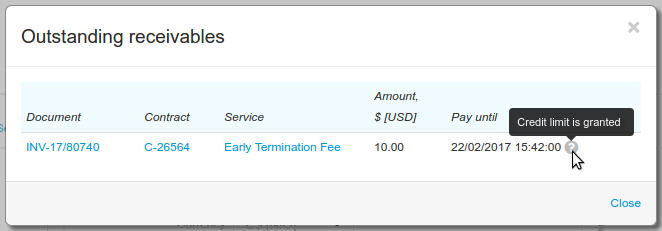
If these receivables are still unpaid after a temporary credit limit is over (or after canceling a permanent one), then late payment fees are to be applied to them, including the days when the limit has been in force.