Phone Price Plans
In this section
Make sure that a price plan contains prices for all phone services which can be provided to a customer, even if they are free. If a customer generates traffic that can be regarded as a service according to traffic classes settings, but it is not included into the price specification, then this traffic cannot be rated, and becomes unaccounted.
Price Plan 1. Local Phone Calls
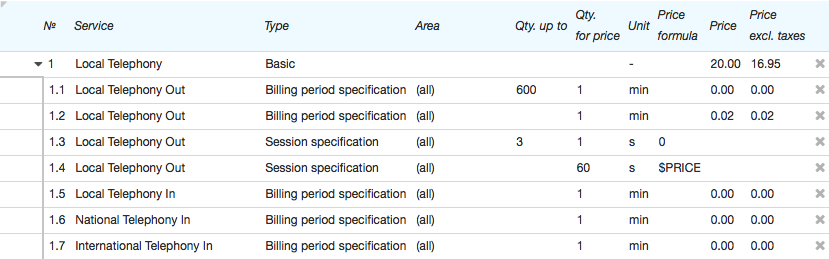
A subscription fee for the Local Phone Calls price plan is $20 (row 1). The price plan includes 600 minutes of outbound local phone calls (row 1.1). If a customer exceeds this amount, outbound phone calls cost $0.02 per minute (row 1.2).
Calls are rated per minute (row 1.4), whereas those lasting less than 3 seconds are free (row 1.3).
Rows from 1.5 to 1.7 set zero price for all inbound calls.
Price Plan 2. Long-Distance Phone Calls Based on Area Codes
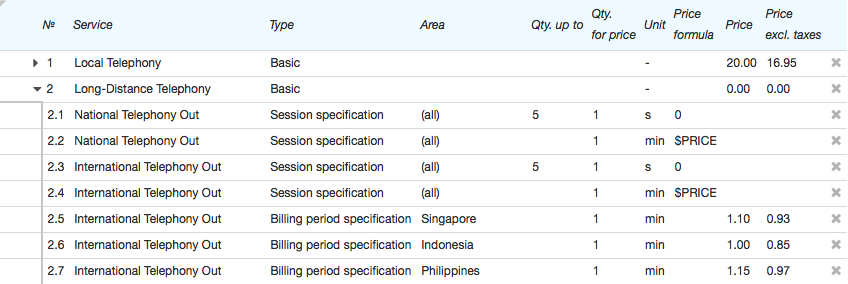
The subscription fee for the Long-Distance Phone Calls price plan is $0 (row 2). Calls are rated per minute (rows 2.2 and 2.4), and calls lasting less than 5 seconds are free (rows 2.1 and 2.3).
Rows starting from 2.5 set prices for outbound phone calls for each area code.
Note that the first rows in such price plans should be of the Session specification type, so they can be easily found after adding prices for area codes (as well as after adding new codes). For your convenience, area codes with prices can be loaded from a file.
Rows containing prices for inbound calls need not be included into the price plan for long-distance phone calls in case all customers are mandatorily subscribed to a price plan for local calls.
When the price plan for long-distance phone calls is independent and a customer can be subscribed to it separately from a price plan for local calls, you need to add rows for inbound calls into it (see price plan 1, rows 1.5–1.7).
Price Plan 3. Long-Distance Phone Calls Based on Groups of Area Codes
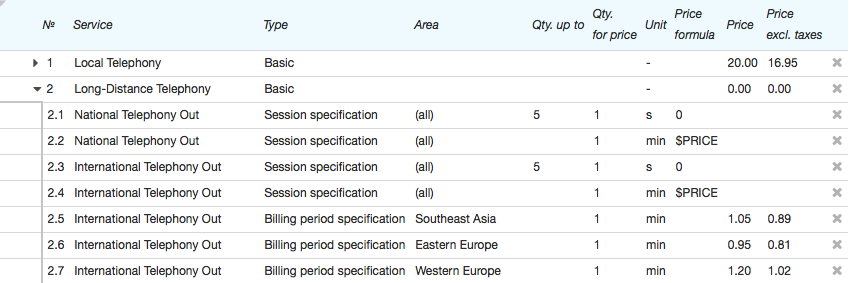
The subscription fee for the Long-Distance Phone Calls price plan is $0 (row 2). Calls are rated per minute (rows 2.2 and 2.4), and those lasting less than 5 seconds are free (rows 2.1 and 2.3).
Rows starting from 2.5 set prices for outbound calls for each group of area codes.
Note that the first rows in such price plans should be of the Session specification type, so they can be easily found after adding prices for groups of area codes (as well as after adding new groups). For your convenience, groups of area codes with prices can be loaded from a file.
Rows containing prices for inbound phone calls need not be included into the price plan for long-distance phone calls in case all customers are mandatorily subscribed to a price plan for local calls.
When the price plan for long-distance phone calls is independent and a customer can be subscribed to it separately from the price plan for local calls, you need to add rows for inbound calls into it (see price plan 1, rows 1.5–1.7).
Price Plan 4. With a Purchase Price Specification
Purchase price specifications are commonly used when providing long-distance phone services based on a big number (from hundreds up to thousands and tens of thousands) of area codes with different prices. All of the prices should be defined in the specification, moreover, they can be often changed, and the selling prices may depend on purchase ones.
A purchase price specification does not differ from a regular one except that it corresponds to a contract which specifies Provider as the supplier, who provides phone services for purchasing, whereas Client is not a customer but a service provider.
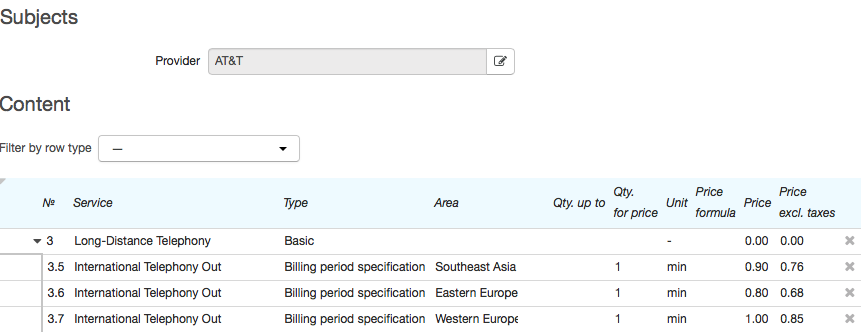
In the specification shown above, Provider is the AT&T company. The price plan with a zero subscription fee specifies prices for outbound long-distance calls depending on the group of area codes.
To resell the traffic purchased according to the specification above, you should create one more price specification. In it, fill in Provider with the service provider that has been defined as Client in the purchase contract.
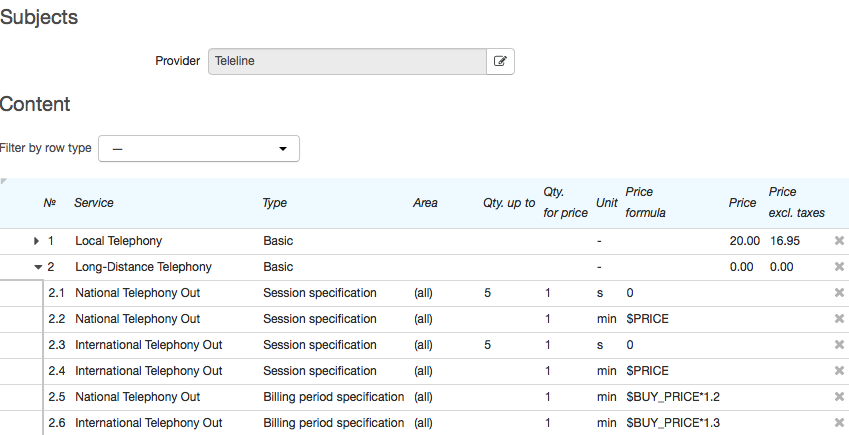
The subscription fee for the Long-Distance Phone Calls price plan is $0 (row 2). Calls are rated per minute (rows 2.2 and 2.4), and those lasting less than 5 seconds are free (row 2.1 and 2.3).
Rows 2.5 and 2.6 specify the price formulas for all long-distance outbound phone calls. See Price formula with the special $BUY_PRICE substitute used for this purpose.
The $BUY_PRICE*1.2 formula allows reselling at a 20 % higher price than the purchase one.
Another example of applying the formula: MIN(MAX($BUY_PRICE*1.3, 0.1), 0.48) — the formula specifies the selling price 30 % higher than the purchase one, but not lower than $0.1 and not higher than $0.48.
For certain (for example, most important or advertised) area codes you can set special prices. To do so, add a new row to the price plan and enter the necessary area code or a group of area codes in Area. Place this row higher than a similar row with the All area code. Prices can depend on the purchase ones (Price formula is to be filled in), or be fixed (Price is to be filled in).
You need not include rows with prices for inbound calls in the price plan for long-distance phone calls in case all customers are mandatorily subscribed to a price plan for local calls.
When the price plan for long-distance phone calls is independent and a customer can be subscribed to it separately from a price plan for local calls, you need to add rows for inbound calls into it (see price plan 1, rows 1.5–1.7).